

Contents
Why Does the Material of a WiFi Enclosure Matter?
When installing outdoor WiFi, protecting your access points is essential for performance and reliability. The material of your enclosure directly affects how well your WiFi signal performs, how durable the housing is, and how much maintenance it requires.
Outdoor environments expose equipment to rain, dust, vandalism, and extreme temperatures. The right enclosure material needs to:
- Protect against weather and corrosion
- Withstand impact and tampering
- Allow strong, uninterrupted signal transmission
Choosing the correct material ensures consistent connectivity and reduces downtime.
What Are the Benefits of Polycarbonate Access Point Enclosures?
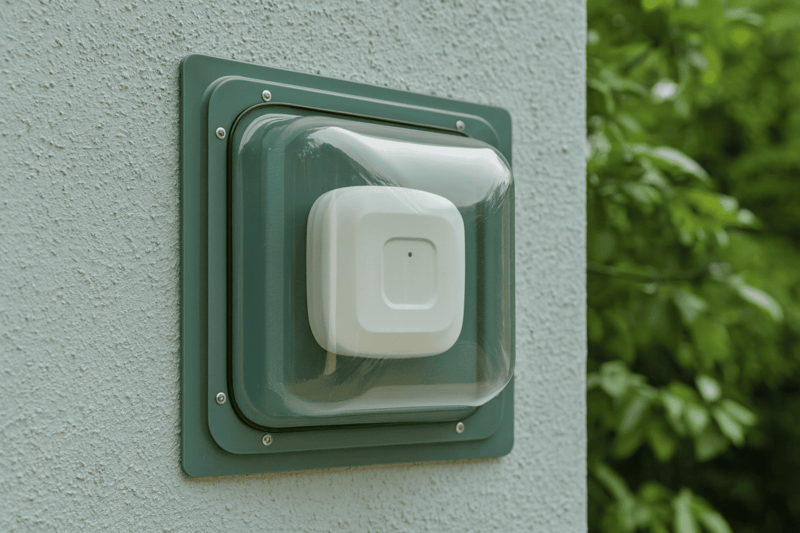
Polycarbonate enclosures are a popular choice for both indoor and outdoor networks because they offer strong protection without interfering with WiFi signals.
Key advantages:
- Highly impact-resistant and UV-stable, making them ideal for long-term outdoor use
- RF-transparent, meaning WiFi signals pass through easily without needing an external antenna
- Lightweight and easier to mount than metal alternatives
- Corrosion-proof — they won’t rust or degrade in damp conditions
Explore Oystashell’s range of Polycarbonate wireless acess point enclosures for the full product specifications.
Things to keep in mind:
- They don’t offer electromagnetic interference (EMI) shielding
- Can scratch under repeated impact
- Usually cost a little more upfront than basic metal boxes, though often cheaper to maintain long-term
When Should You Choose Metal Enclosures?
Metal enclosures—typically stainless steel or aluminium—are built for more extreme environments. They provide excellent mechanical protection but can reduce signal performance if not installed correctly.
Key advantages:
- Exceptional strength and heat resistance
- Built-in EMI shielding for environments with strong electrical interference
- Suitable for harsh industrial, marine, or chemical-exposed locations
Things to consider:
- Metal blocks WiFi signals unless an external antenna is used
- Heavier, increasing installation effort
- May corrode or need upkeep without proper coatings or stainless steel grades
Polycarbonate vs Metal Enclosures: Quick Comparison
| Feature | Polycarbonate | Metal |
|---|---|---|
| WiFi Signal Transparency | Excellent | Poor without external antenna |
| Weight & Handling | Lightweight and easy to install | Heavy, requires support |
| Corrosion Resistance | High, no rust | Depends on coating or material |
| Impact Resistance | Excellent | High but may dent |
| EMI Shielding | None | Built-in |
| Maintenance | Minimal | Moderate to high |
| Best Use | Outdoor WiFi, schools, healthcare, public areas | Industrial, high-EMI, marine environments |
How Do You Choose the Right Enclosure Material?
The best material depends on your project’s location and requirements. Consider these factors before purchasing:
Polycarbonate performs best in typical outdoor and public environments, while metal is ideal for industrial sites or corrosive settings.
Polycarbonate enclosures maintain stronger WiFi coverage if antennas are inside.
Metal may be preferred for anti-ligature or tamper-resistant applications.
Lightweight materials like polycarbonate make wall or pole-mount installs faster and safer.
While metal may appear cheaper initially, polycarbonate’s lower maintenance often makes it more cost-effective long-term.
Real-World Examples
- Education: Schools often choose polycarbonate enclosures for outdoor WiFi due to their durability and signal clarity.
- Healthcare: Polycarbonate is non-conductive and tamper-resistant, making it suitable for hospitals and mental health facilities.
- Industrial Sites: Metal housings are often used in factories or marine environments where heat, chemicals, or mechanical stress are extreme.
Summary: Which Is Best for Your Network?
For most outdoor WiFi installations, polycarbonate access point enclosures provide the best balance of protection, signal performance, and low maintenance.
Metal enclosures still have their place in very harsh or high-interference settings, but they typically require extra planning for antennas and installation.
If reliable connectivity and minimal maintenance are your priorities, polycarbonate is the smarter, more efficient choice.
Frequently Asked Questions
Yes. Metal can act as a shield, significantly reducing WiFi strength if the antenna is enclosed. Always use an external antenna if choosing metal.
Absolutely. Polycarbonate is impact-resistant and often used for safety shields and public infrastructure.
Yes. They’re UV-stabilised and weatherproof, making them suitable for all UK outdoor environments.
Opt for metal if you need EMI shielding or you’re installing in an extreme environment such as a factory or marine site.
 Return to blog