
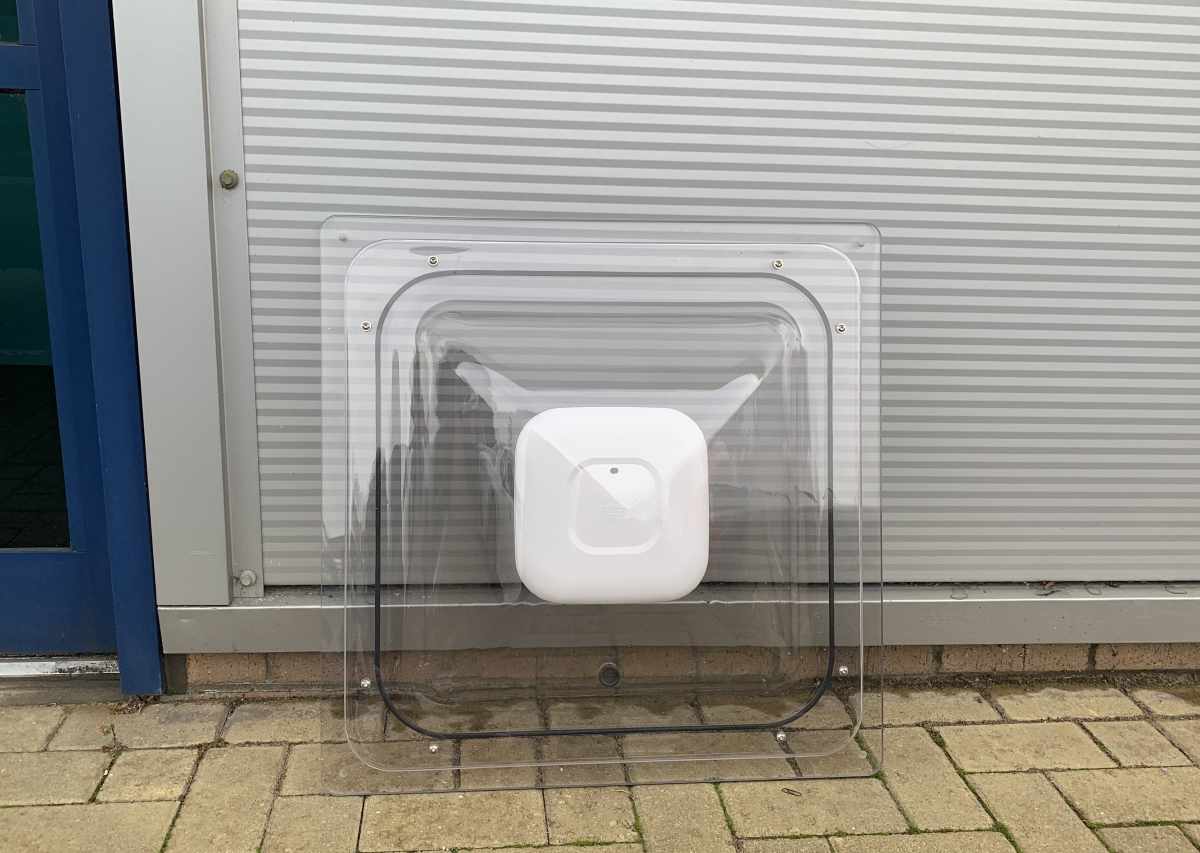
At a Glance
Anti-tamper Wi-Fi enclosures restrict unauthorised access while protecting wireless access points (WAPs) from impact and interference. Effective designs combine secure fixings, high-impact materials, anti-ligature profiles, ventilation and RF transparency. Selecting the right enclosure also requires considering the access point, mounting arrangement, installation conditions and the environment’s safety requirements.
Call us, email us or submit the contact form for more information or to discuss your requirements.
Who Is This Article For?
Healthcare and mental health facilities: Looking to restrict access to wireless equipment while supporting wider safety requirements.
Custodial and secure facilities: Protecting access points from deliberate interference, tampering and unauthorised access.
Schools and public buildings: Reducing opportunities for users or visitors to interfere with exposed wireless equipment.
IT, estates and facilities teams: Assessing enclosure construction, fixing methods, access-point compatibility and installation requirements before specifying a solution.
Questions This Article Answers
- What is an anti-tamper WAP?
- What makes a Wi-Fi enclosure anti-tamper?
- How do anti-tamper fixes restrict unauthorised access?
- What materials are used in anti-tamper Wi-Fi enclosures?
- Can an anti-tamper enclosure affect Wi-Fi performance?
- How should an anti-tamper enclosure match the access point?
Understanding Anti-Tamper Protection for Wireless Access Points
Wireless access points are usually installed in accessible areas to provide reliable coverage throughout a building. In healthcare, custodial, education and public environments, however, the equipment may also be exposed to interference, impact or attempts to gain access.
For estates and IT teams asking what an anti-tamper WAP is, the answer lies in how the enclosure controls physical access without compromising the equipment’s purpose. Its construction and installation must protect the access point while fitting the safety requirements of the surrounding environment.
For organisations looking to apply these principles to their Wi-Fi infrastructure, Oystashell® provides protective enclosures designed around access point compatibility and installation requirements. The range is designed for environments where wireless equipment may face physical risks.
What Is An Anti-Tamper WAP Enclosure?
An anti-tamper Wi-Fi enclosure is a protective housing that restricts unauthorised access to a wireless access point. It uses physical protection and secure fixing methods to make interference, removal or damage more difficult, while retaining controlled access for authorised maintenance only.
In higher-risk environments, this protection must also complement anti-ligature requirements. The enclosure should therefore be designed as part of the building’s wider safety infrastructure, not as a simple protective box.
To Summarise: Anti-tamper protection combines the enclosure’s physical construction, secure fixing and profile to restrict unauthorised access to the WAP without preventing controlled maintenance.
Anti-Tamper Wi-Fi Enclosures – Myth vs Fact
| Myth | Fact |
| Anti-tamper means the enclosure cannot be removed and is permanently sealed. | An anti-tamper design makes unauthorised removal or interference more difficult, but authorised access is still available. |
| A strong material alone makes an enclosure anti-tamper. | Material is only one part of the design and factors like fixings, enclosure profile and installation also influence tamper resistance. |
| Anti-tamper and anti-ligature mean the same thing. | No, they address different risks. Anti-tamper features restrict unauthorised access and physically shield the equipment from damage, while anti-ligature design aims to reduce potential attachment points. |
| An anti-tamper enclosure does not need to be accessible to maintenance teams. | Authorised engineers still need controlled access to inspect, service and replace the equipment. |
Key takeaway: Anti-tamper protection comes from a combination of secure access, enclosure construction and installation, not just a single feature.
The Key Features of an Anti-Tamper Wi-Fi Enclosure
Several features define an anti-tamper Wi-Fi enclosure, including its physical construction, fixing methods, profile and technical performance. Fixings control access, materials provide impact protection, the enclosure profile addresses safety and the construction allows the WAP to continue operating effectively.
Here are some of the top features of an anti-tamper Wi-Fi enclosure to look for:
1. Secure Fixings That Prevent Unauthorised Access
Secure fixings are the first physical barrier between the equipment and anyone attempting to interfere with it. Look for anti-tamper screw kits that make the enclosure harder to remove without the appropriate tools, helping keep the WAP and its connections protected.
Oystashell provides an anti-tamper screw kit as an additional option, allowing the enclosure to be secured. This helps ensure maintenance teams have controlled access so engineers can still remove the enclosure when equipment needs to be serviced or replaced.
2. Strong Material That Resists Impact and Damage
The enclosure must withstand the physical demands of its location, as Oystashell does, using 3mm shatterproof, riot-shield-grade polycarbonate across its Wi-Fi range to provide impact resistance while remaining RF transparent.
Material selection matters, especially in healthcare and behavioural environments where metal enclosures can introduce hard edges, gaps or accessible points. These metal enclosures may increase ligature risks, whereas polycarbonate can provide a protective structure with rounded, anti-ligature forms.
3. Enclosure Designs That Reduce Tampering Opportunities
An enclosure’s profile determines what can be accessed, gripped or attached from outside. However, rounded edges and flush mounting reduce exposed features that could provide opportunities for interference.
These principles underpin effective anti-tamper enclosure designs and support anti-ligature objectives, as protection needs must be achieved without replacing one physical risk with another.
4. Balancing Security, Ventilation and Wi-Fi Performance
A protective enclosure must still allow the WAP to perform its intended function. Adequate internal clearance and ventilation help manage heat, similar to how Oystashell uses ventilation apertures below 2 mm to support airflow while maintaining its anti-ligature design. RF transparent construction allows wireless signals to pass through the enclosure.
In terms of Wi-Fi performance, Oystashell typically has about 1 dB of signal reduction across 2.4 GHz and 5 GHz, with negligible attenuation at 6 GHz. This helps ensure physical protection doesn’t create an unnecessary barrier to network performance.
Key takeaway: An effective anti-tamper enclosure combines secure fixing, durable construction, a considered profile and appropriate ventilation and RF performance. These features work together to make unauthorised access more difficult while supporting reliable operation and authorised maintenance.
How to Choose an Anti-Tamper Wi-Fi Enclosure?
Choosing an anti-tamper enclosure starts with the access point itself. The enclosure must match the access point and installation requirements, similar to how we at Oystashell design enclosures around specific access point dimensions and mounting arrangements so that you can select the right model for the equipment and environment.
- Oystashell® 1: designed for standard ceiling and wall-mounted access points.
- Oystashell® 1D: provides additional depth for larger enterprise hardware.
- Oystashell® 1DW: combines the deeper format with moisture-resistant protection for larger access points in high-moisture environments.
- Oystashell® 1N & 1NW: provide narrower configurations for restricted mounting space.
- Oystashell® 1S: designed for smaller access points with limited installation space.
The installation method can also influence the choice, with Oystashell® 2 designed for suspended ceiling integration and Oystashell® 3 providing the dedicated weather-resistant outdoor Wi-Fi option.
Teams assessing what an anti-tamper WAP is should consider the enclosure and installation conditions to avoid unnecessary compromises. Ultimately, the right specification should protect the hardware, preserve wireless functionality and meet the space’s safety needs.
Anti-Tamper Enclosure Specification Checklist
When considering what an anti-tamper WAP is and assessing anti-tamper enclosure designs, consider the following questions:
- Is the enclosure compatible with the specific access point model?
- How is the enclosure secured against unauthorised removal?
- Can authorised engineers access the equipment for maintenance?
- Is the enclosure made from a material suitable for the physical risk at the installation?
- Does the design address relevant anti-ligature requirements?
- Will the enclosure allow adequate airflow around the access point?
- Is the enclosure RF transparent?
- Is the model suitable for the mounting position and environmental conditions?
These checks help determine whether the enclosure has the features that define an anti-tamper Wi-Fi enclosure and suits the access point and its installation requirements. Next, consider whether an anti-tamper enclosure fits the site’s risks and conditions.
Is an Anti-Tamper Wi-Fi Enclosure the Right Approach?
An anti-tamper enclosure is useful when the Wi-Fi access point is physically accessible and interference is a risk. Its anti-tamper enclosure design adds a physical layer around the equipment, making unauthorised access, removal or interference more difficult.
However, an enclosure does not solve every installation requirement on its own. The access point still needs to fit the enclosure, the enclosure needs to suit the installation environment and any other wider safety or supervision requirements still need to be addressed.
What Exposed Wi-Fi Equipment Can Leave at Risk?
Below is an example of what NOT to do. The image shows a wireless access point installed within a suspended ceiling, with the equipment and cabling left exposed. In an accessible or higher-risk environment, this type of installation can leave the WAP more vulnerable to accidental damage and unauthorised access.
Exposed equipment can create several points of vulnerability:
- The access point: Directly accessible equipment may be easier to interfere with or damage.
- Cabling and connections: Exposed cables can be pulled, disconnected or damaged.
- Installation points: Unprotected equipment may be harder to secure against physical interference.
- Wider safety considerations: In higher-risk environments, exposed equipment and cabling may also need to be considered as part of wider anti-ligature and safety assessments.
Use a protective enclosure to create a physical barrier around the WAP while still allowing authorised engineers to access the equipment for maintenance or replacement.
Common Questions About Anti-Tamper Wi-Fi Enclosures
Can An Anti-Tamper Enclosure Replace Other Security Measures?
No, an enclosure provides physical protection but does not replace required supervision or wider safety measures. Consider the features that define an anti-tamper Wi-Fi enclosure alongside the installation’s wider security and safety requirements.
Does It Make The Access Point Completely Secure?
No physical enclosure can guarantee that equipment cannot be damaged or interfered with. The aim is to create a stronger physical barrier and reduce opportunities for unauthorised access.
Can Authorised Engineers Still Access The WAP?
Yes, an anti-tamper design should restrict unauthorised access while allowing authorised personnel to remove the enclosure when the equipment needs inspection, servicing or replacement. A clear enclosure lets engineers visually assess a WAP without dismantling it.
Where To Go From Here
If an anti-tamper Wi-Fi enclosure suits your installation, start by identifying your access point model, mounting arrangement and environmental requirements. These details can help narrow down the enclosure configuration that best suits your equipment and installation.
Not sure which Oystashell enclosure you need? Use our Product Selector to enter your installation requirements and find the most suitable enclosure for your access point.
Explore Anti-Tamper Wi-Fi Enclosures With Oystashell
If you are still asking what an anti-tamper WAP is and how to protect it in a high-risk environment, Oystashell® Wi-Fi access point enclosures provide a physical barrier against unpredictable situations in high-risk spaces, with configurations for different access point sizes and mounting requirements.
The range features anti-tamper and anti-ligature design principles, high-impact polycarbonate construction and RF-transparent materials, plus a dedicated range of CCTV covers with the same toughness and structural integrity.
For more technical information, compatibility guidance or help choosing an enclosure for a specific installation, call us, email us or submit the contact form to connect with our experts today.