
At a Glance
Wi-Fi access point covers need to withstand more than occasional impact. Their durability depends on high-impact construction, secure fixings, anti-ligature design, correct installation and RF transparency. The right enclosure should protect wireless hardware from physical interference while maintaining connectivity and meeting the demands of its specific environment.
Interested in knowing more? Call us to discuss your Wi-Fi protection requirements, email your queries or submit our online form to connect.
Why Wi-Fi Access Point Protection Requires More Than Tough Materials
Wi-Fi access points are rarely installed in quiet, protected spaces. In a hospital corridor, school, prison, warehouse or public building, the equipment often has to sit exactly where it can provide reliable coverage. However, that also leaves it exposed to accidental impact, deliberate interference and, in higher-risk environments, safety concerns that wouldn’t apply to ordinary office networking.
So, just how tough are Wi-Fi access point covers?
The answer depends on more than how strong the outer shell feels. A suitable enclosure needs to withstand the physical conditions around the access point while also addressing installation, tampering, airflow, wireless performance and the specific risks of the building.
For estates and IT teams, the useful question is therefore not simply how tough Wi-Fi access point covers are, but also whether the enclosure provides the right level of Wi-Fi hardware protection without creating another operational problem.
Who Is This Article For?
This guide is intended for estate managers, healthcare planners, IT infrastructure managers, facilities teams, architects, contractors and custodial or educational teams responsible for exposed wireless infrastructure.
It is particularly relevant where moving an access point out of a ward, corridor, classroom, communal area or other operational space would compromise the coverage that the network needs to provide.
Quick Answers
- How tough are Wi-Fi access point covers? Purpose-built covers, like those from Oystashell®, provide substantial resistance to impact, tampering and everyday physical interference, but no enclosure should be considered indestructible.
- How durable are Wi-Fi access point covers? The durability of Wi-Fi access point covers depends on the material, construction, fixing system, dimensions, airflow and suitability for the installation environment. Oystashell® covers are designed with anti-tamper and anti-ligature needs in mind.
- What is a tough Wi-Fi enclosure made from? Specialist manufacturers of protective enclosures for Wi-Fi access points, such as Oystashell®, use 3mm riot-shield-grade polycarbonate across their range of enclosures, offering Wi-Fi hardware protection combined with high impact resistance and RF transparency.
- Does a protective cover affect Wi-Fi? A correctly designed RF-transparent enclosure, including those from Oystashell®, protect the access point while allowing wireless signals to pass through with minimal interference.
Why Do Wi-Fi Access Points Need Protective Covers?
An access point is a network component, but its location also makes it part of the physical environment. If it is mounted in a corridor, communal area or another accessible position, it can be knocked or deliberately damaged.
Relocating the equipment may appear to solve the physical problem, but it can introduce a connectivity problem. Wi-Fi coverage depends on where access points are positioned, so putting them inside cupboards, restricted rooms or poorly suited ceiling voids can affect the network where connectivity is actually needed.
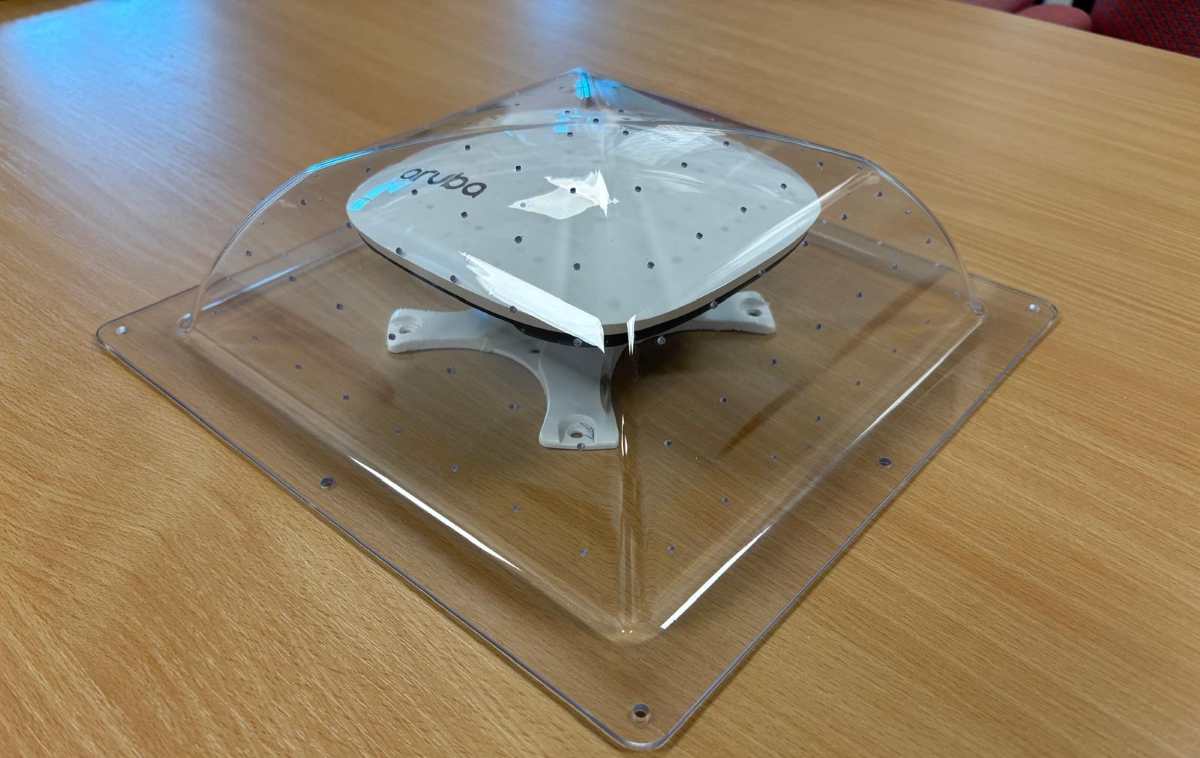
A protective enclosure takes a different approach and instead of hiding the access point, it creates a physical barrier around it so the hardware can remain in an appropriate position. Oystashell’s range of enclosures is designed around this principle, with surface-mounted, narrow, deeper, suspended-ceiling and outdoor configurations for different deployment conditions.
Durability is only one part of the decision, as the enclosure must also work with the access point, the mounting location and the facility’s safety requirements.
How Tough Are Wi-Fi Access Point Covers?
The required strength of a Wi-Fi enclosure depends on what it is expected to protect against. A cover designed for a low-traffic office has a different job from one installed in a mental health facility, prison, sports hall or industrial building.
Oystashell uses polycarbonate for its Wi-Fi covers and the material is shatter-resistant and designed to provide a substantial physical barrier around exposed wireless hardware.
However, toughness should not be reduced to material thickness alone.
So, when you ask, “How strong are Wi-Fi access point covers?” consider more than physical strength. This matters because physically tough Wi-Fi enclosures can still be unsuitable if they don’t provide enough clearance, cannot be securely fixed or are used beyond their intended specifications. These limitations often lead to common misconceptions about what “toughness” actually means.
Myths vs Facts
Myth: The strongest Wi-Fi cover is simply the thickest one
Fact: Material strength is crucial, but so is the complete enclosure design because it determines how useful that strength is. The cover needs to work with the device, mounting surface and surrounding conditions.
Myth: Physical protection requires a metal cage
Fact: Alternative materials, such as non-metallic polycarbonate, provide physical protection while remaining RF transparent. These tough Wi-Fi enclosures protect the device while maintaining wireless performance, with typical signal reduction of about 1 dB across 2.4 GHz and 5 GHz.
What Are Wi-Fi Access Point Covers Made Of?
At Oystashell, our enclosures are made of polycarbonate, which is well suited to the requirements of being shatter-resistant. They are also recyclable and come in clear finishes that let engineers see device indicators without removing the enclosure, which is useful during routine maintenance.
Some models introduce additional construction features for specific environments. For example, the Oystashell® 1DW combines the deeper enclosure format with a water-resistant neoprene gasket for larger access points in moisture-prone locations such as kitchens and laboratories.
The material therefore establishes the foundation, but the enclosure’s configuration determines how the protection works in practice.
What Actually Makes a Wi-Fi Access Point Enclosure Durable?
1. High-Impact Construction
When considering how durable Wi-Fi access point covers are, remember they need to provide a barrier between the access point and the physical environment.
Oystashell’s 3mm polycarbonate construction is designed to resist impact and everyday physical interference while avoiding the brittleness associated with materials that can fracture under force.
2. Protection Against Tampering
Impact is not the only risk and an exposed access point can also be deliberately handled or interfered with. Tamper-resistant security fixings help restrict access while allowing maintenance teams to remove the enclosure when servicing the equipment.
For this reason, Oystashell offers anti-tamper screw kits across its Wi-Fi range, helping secure enclosures without preventing authorised access. This means facilities teams can maintain and service the equipment when required while keeping the enclosure protected against unauthorised tampering.
3. Anti-Ligature Design
In behavioural healthcare and custodial environments, enclosure design also needs to be looked at from a safety perspective. Smooth, tapered profiles and small ventilation openings can help reduce potential ligature opportunities around exposed infrastructure.
This is why Oystashell enclosures incorporate anti-ligature features that work alongside other protective measures.
4. Secure Installation
A strong shell cannot compensate for an unsuitable installation. The fixing method, mounting surface, access point position and available clearance all affect how effectively the enclosure performs.
This is also why Oystashell offers different physical formats. For example, the Oystashell® 2 replaces a standard suspended ceiling tile and houses the access point above the ceiling grid, creating a more integrated installation.
5. Access Point Compatibility
The enclosure must match the equipment inside it, so dimensions and internal clearance are crucial as modern enterprise access points grow larger.
The Oystashell® 1D is designed for larger hardware such as the Aruba 535, the Aruba 635 and the Cisco Meraki MR44, while the smaller 1S is intended for compact devices such as the Aruba 305.
Although the article focuses on Wi-Fi, the same principle applies to Oystashell’s CCTV enclosures and the range includes the standard Oystashell® 4, corner-mounted 4C, larger 4L and specialist 4-360 for the Verkada CF83-E fisheye camera.
6. RF-Transparent Design
Physical protection should not interfere with the access point’s function. The enclosure needs to withstand impact and tampering while allowing radio signals to pass through without significant interference.
This is why Oystashell uses polycarbonate instead of conventional metal cages. Its RF-transparent properties help maintain wireless connectivity while the enclosure provides a durable protection layer around the hardware.
Where Do Tough Wi-Fi Access Point Covers Make The Biggest Difference?
1. Healthcare and Mental Health Facilities
Healthcare estates need reliable connectivity across wards, corridors and communal spaces while also considering the physical environment around exposed infrastructure. A protective enclosure can keep an access point in its required position while adding impact, tamper and anti-ligature protection.
2. Educational Buildings
Schools, colleges and universities have busy circulation areas, sports spaces and communal facilities where networking hardware can be vulnerable to accidental damage. The range includes compact covers for smaller equipment as well as deeper models for larger enterprise access points.
3. Custodial and Secure Environments
In custodial settings, relocating network equipment may not be practical simply to make it harder to reach. Instead, anti-ligature design and controlled maintenance access can be incorporated into the physical protection around the access point.
4. Commercial and Public Buildings
Hotels, offices, transport facilities and public buildings may have different priorities, including appearance and ease of maintenance. The Oystashell 2 is particularly relevant where a suspended-ceiling installation needs to accommodate Wi-Fi without leaving a prominent enclosure exposed below the ceiling grid.
5. Outdoor and Industrial Locations
External and industrial installations introduce additional considerations such as moisture, dust, dirt and changing environmental conditions.
The Oystashell® 3 is specifically designed as a water-resistant outdoor enclosure, using a backplate, spacers and a waterproof cable grommet to allow an indoor access point to be deployed outside. Simply specify the required configuration and choose from other variants that provide additional internal clearance for larger access points, if needed.
Which Oystashell Wi-Fi Cover Is Right for Your Access Point?
| Oystashell model | Where it fits |
| Oystashell 1 | Standard indoor access points, including Meraki MR36 and Aruba 505 |
| Oystashell 1D | Larger enterprise APs such as Aruba 535, Aruba 635 and Meraki MR44 |
| Oystashell 1DW | Larger APs where water-resistant protection is required |
| Oystashell 1N | Narrow installation with limited ceiling or wall space |
| Oystashell 1NW | Smaller, narrow format installations requiring water-resistant protection |
| Oystashell 1S | Micro Wi-Fi devices and compact spaces |
| Oystashell 2 | Suspended ceiling installation using a ceiling tile format |
| Oystashell 3 | Outdoor installations using water-resistant enclosures |
| Oystashell 3D | Larger APs requiring additional clearance |
The right choice starts with the access point’s dimensions, then moves to the surrounding conditions. Size, mounting position, moisture exposure, available space and required safety features all need to be considered together.
Oystashell Vs A Rubber Mallet – Tamper Resistance Test

Common Questions About Wi-Fi Access Point Cover Toughness
1. Can Wi-Fi Access Point Covers Be Damaged by Impact?
Oystashell covers are extremely tough. Made from high-impact polycarbonate, they are designed to withstand substantial force and resist damage from everyday impacts, tampering and misuse. That being said, no protective enclosure can guarantee complete resistance to extreme force and in exceptional circumstances, severe impact could still damage the enclosure.
2. What Happens When a Wi-Fi Enclosure Is Hit?
The enclosure provides a physical barrier intended to absorb or withstand the impact before it reaches the access point itself. The level of protection will depend on the severity and nature of the impact, however, as an example of their durability, they have proven to withstand being hit by a rubber mallet and hammer several times.
3. Can Repeated Impacts Weaken a Wi-Fi Access Point Cover?
Any material can eventually show damage after sufficient repeated or severe impact. In demanding environments, visual inspection and proper maintenance remain important even with a robust enclosure.
4. Can the Enclosure Protect The Access Point Without Affecting The Signal?
Yes, RF-transparent polycarbonate is specifically used to minimise interference with wireless transmission. Oystashell reports typical signal reduction of around 1 dB across standard 2.4 GHz and 5 GHz frequency bands.
5. Are Wi-Fi Access Point Covers Vandal-Proof?
Our products aren’t completely vandal-proof, but they provide a level of protection that few other enclosures can guarantee. A more accurate description is resistant to impact, tampering or physical interference.
6. Can a Wi-Fi Access Point Enclosure Be Used in Demanding Environments?
Yes, provided the model is appropriate for the equipment and environment. Oystashell’s range covers indoor, narrow, moisture-prone, suspended ceiling and outdoor deployments.
7. How Tough Does A Wi-Fi Access Point Cover Need To Be?
It needs to reflect the actual condition at the installation site. For example, a busy public corridor, secure healthcare environments and exposed industrial locations may each require different levels of physical and safety protection.
Where To Go From Here
The useful starting point is not simply asking which cover is the strongest. First establish the access point model and dimensions, then consider where it will be installed and what it will be exposed to.
From there, assess whether the installation requires deeper clearance, a narrow footprint, water resistance, suspended ceiling integration, anti-tamper fixings or anti-ligature considerations. This approach avoids selecting an enclosure based on strength alone and ensures the protection matches the actual infrastructure requirements.
Oystashell provides protective Wi-Fi enclosures for these different installation requirements, with models designed for major enterprise hardware and a 3-year warranty across the range.
Protect Your Wi-Fi Access Points With Oystashell
Oystashell provides specialist protective enclosures for Wi-Fi access points and CCTV equipment used in healthcare, custodial, education, commercial, public and industrial environments.
The range includes compact, deeper, narrow, water-resistant, suspended ceiling and outdoor Wi-Fi enclosures, alongside dedicated CCTV covers for standard, corner, larger and 360° camera installations.
For product compatibility, installation requirements or guidance on selecting the right enclosure for a specific environment, call, email or submit our online form to Oystashell today.