
At a Glance
When Wi-Fi access points are installed in exposed, busy or high-risk areas, the enclosure around the hardware needs to do more than protect it from physical damage. The material must also work with the access point, particularly when wireless signals need to pass through the enclosure without unnecessary interference. Choosing between polycarbonate and metal access point enclosures deserves careful consideration. Both materials provide physical protection, but they differ in RF performance, weight, corrosion resistance, installation requirements and the environments in which they are most suitable.
For help choosing the right enclosure for your application, call, email or submit an online form.
Why Does the Material of a Wi-Fi Enclosure Matter?
The material used for a Wi-Fi enclosure affects both the protection it provides and the enclosed access point’s performance. In outdoor and demanding environments, equipment may be exposed to rain, moisture, dust, temperature fluctuations, accidental impacts and tampering. At the same time, indoor installations may face different risks, such as vandalism and interference.
A suitable enclosure should protect the hardware without creating new network problems. When comparing polycarbonate vs metal Wi-Fi enclosures, consider:
- Wireless performance, as the material should enable the access point to transmit and receive RF signals effectively.
- Physical protection, because the enclosure should withstand impact, accidental damage and attempts to interfere with the equipment.
- Environmental resistance, as outdoor and high-moisture installations may require additional protection beyond the enclosure material itself.
- Installation, because weight, dimensions and mounting requirements affect how easily the enclosure can be fitted around existing hardware.
- Maintenance, as IT and facilities teams need to inspect and maintain equipment without unnecessary disruption.
Remember that material is only one part of the decision and the enclosure’s design, dimensions, fixing system and resistance to moisture or environmental exposure must also match the access point and its location.
What Are the Benefits of Polycarbonate Access Point Enclosures?
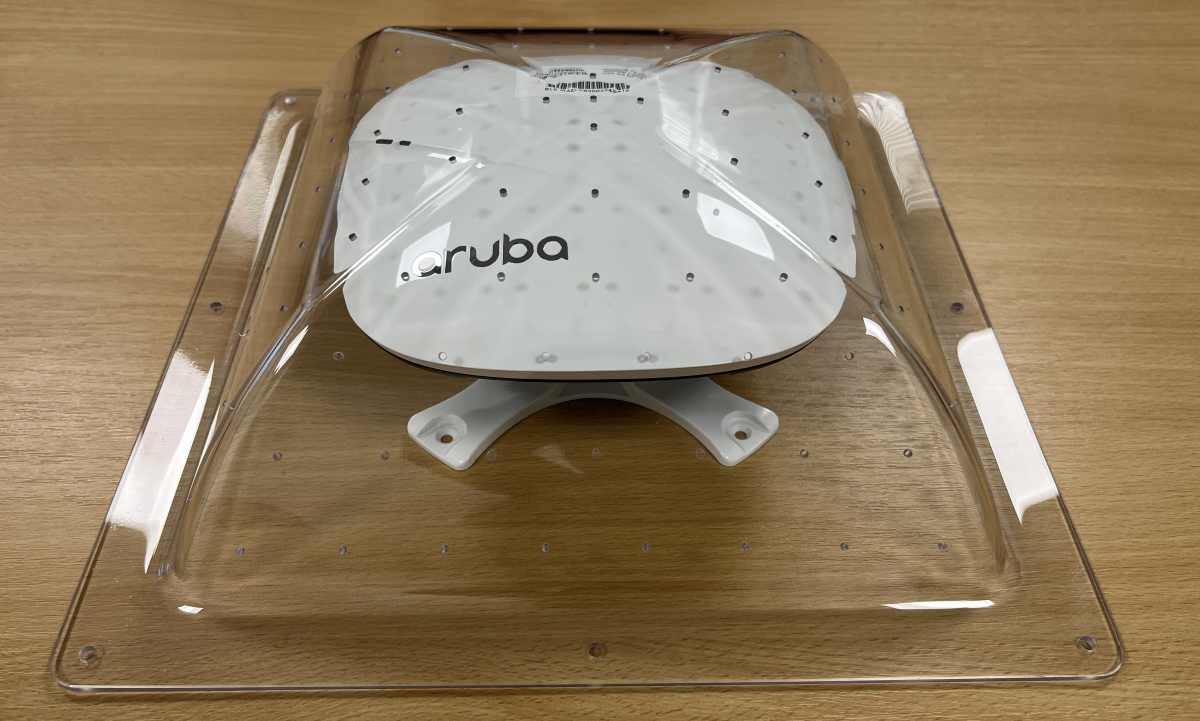
Polycarbonate is widely used for protective Wi-Fi enclosures because it combines high impact resistance with relatively low weight and offers RF transparency. For example, the Oystashell® range of protective Wi-Fi enclosures offers 3mm shatterproof, riot-shield-grade polycarbonate with different configurations designed around access point size and installation requirements.
One of the most important properties for Wi-Fi is RF transparency. Unlike a conductive metal enclosure, polycarbonate allows radio signals to pass through the protective cover with minimal interference. Oystashell’s enclosures typically produce around 1dB of signal reduction across 2.4 GHz and 5 GHz, with negligible attenuation reported at 6 GHz.
Polycarbonate is also lighter than many metal alternatives, which can make handling and installation more practical, mainly when multiple access points need to be protected across an occupied building. It does not rust like ferrous metals, although an enclosure’s suitability for a particular outdoor or corrosive environment depends on the overall design, not the material alone.
There are some limitations to consider – for example, polycarbonate does not provide the EMI shielding associated with metal and may be susceptible to scratches from repeated abrasion. This again highlights the importance of considering the installation’s demands before choosing your enclosure.
When Should You Choose a Metal Enclosure?
Metal enclosures can be useful when electromagnetic interference shielding or specific industrial requirements matter more than RF transparency.
Aluminium and stainless steel, for example, can provide high mechanical strength. However, metal is generally heavier than polycarbonate and may require greater consideration while mounting.
It also doesn’t offer corrosion protection, which makes it less practical as enclosures have to be lightweight, corrosion-resistant and compatible with RF performance.
Polycarbonate vs Metal Access Point Enclosures– Quick Comparison
| Feature | Polycarbonate | Metal |
| Wi-Fi signal transparency | RF-transparent and designed to minimise signal interference | Can attenuate or reflect RF signals, depending on enclosure and antenna design |
| Weight & handling | Generally lightweight and easier to handle | Comparatively heavier and may require additional support |
| Corrosion resistance | Does not rust like ferrous metal | Depends on the metal coating and installation environment |
| Impact resistance | High impact resistance | High mechanical strength, but performance depends on metal and construction |
| EMI shielding | No inherent EMI shielding | Can provide electromagnetic shielding |
| Maintenance considerations | Resistant to corrosion, but suitability depends on the complete enclosure design | May require corrosion protection or variants with specialised coatings and finishes |
| Typical applications | Wi-Fi protection where RF performance and physical protection are both important | Applications where shielding or specific industrial properties are required |
How Do You Choose the Right Enclosure Material?
Start with the access point itself rather than simply choosing based on the material alone. Check the dimensions, antenna configurations, installation position and operating environment, as these factors determine the appropriate enclosure type.
For many Wi-Fi installations, polycarbonate is particularly useful when maintaining RF performance is a priority. For installations where EMI shielding is essential, a carefully designed metal enclosure may be more appropriate.
Environmental conditions also matter because a standard indoor enclosure should not automatically be treated as suitable for outdoor exposure simply because it is made from polycarbonate. The enclosure should provide an appropriate level of environmental protection for its intended location.
Exploring The Polycarbonate Oystashell® Range
Our Oystashell® 1 is designed for a standard surface-mounted option, and the deeper Oystashell® 1D provides additional space for larger enterprise access points such as Aruba 535, Aruba 635 and Cisco Meraki MR44.
When moisture is a concern, the Oystashell® 1DW adds water-resistant protection for larger wireless hardware. Conversely, narrower installations would suit the Oystashell® 1N and 1NW, while the compact Oystashell® 1S is designed for micro wireless devices.
Installation method matters just as much as size, as it directly determines how and where the access point can be deployed. Keep that in mind, the Oystashell® 2 is designed for suspended ceiling installation and replaces a standard 600X 600 mm ceiling tile, making it suitable for discreet overhead mounting in indoor environments. In contrast, the Oystashell® 3 is purpose-built for outdoor wall installations, using a backplate, spacers and a waterproof cable groomer to protect an indoor access point when installed externally.
Real World Examples
In healthcare and mental health environments, access points may need to remain in exposed positions to provide adequate coverage while also reducing opportunities for tampering or physical interference.
A protective polycarbonate enclosure from Oystashell ensures the equipment stays where network planners need it while reducing the risks associated with exposed access points. Unlike metal enclosures, which can increase ligature risks in healthcare settings, polycarbonate can provide physical protection without introducing the same risks, with features such as anti-ligature profiles and tamper-resistant fixings that provide additional protection against interference.
The same need for physical protection applies to schools, universities, prisons and other public-facing buildings, although the physical layout and equipment requirements can vary considerably. Oystashell offers different enclosures configurations to accommodate different access point sizes and installation requirements, allowing the enclosure to be selected according to the specific application.
These requirements can change further when an access point is installed outdoors or in an area exposed to moisture. Our outdoor Wi-Fi enclosures are designed specifically with water-resistant dome, backplate, airflow spacers and waterproof cable entry, providing protection suited to installations where environmental exposure needs to be considered alongside physical security.
Summary – Which Is Best For Your Network?
There is no universal answer to whether polycarbonate or metal is better for access point enclosures. Metal can have a place where electromagnetic shielding for specific industrial requirements is important, but its weight, corrosion considerations and effect on wireless design need to be assessed as part of the overall installation.
For many Wi-Fi applications, RF-transparent polycarbonate covers offer a practical balance between impact protection, manageable weight and wireless performance. Oystashell’s product range builds on these properties, offering different enclosure sizes and configurations for standard, large, compact, narrow, suspended-ceiling, water-resistant and outdoor installations.
The material is therefore only the starting point, whereas the access point, environment, installation method and safety requirements should all inform the final enclosure choice.
Protect Your Wi-Fi Infrastructure With the Right Enclosure from Oystashell®
Oystashell® provides protective Wi-Fi enclosures in different sizes and configurations to suit access point dimensions, installation environments and safety requirements, including anti-ligature and tamper-resistant designs.
If you need help identifying the appropriate enclosure for your application, call, email or submit our online form to discuss your requirements with the Oystashell® team.